

Here's exactly how the EU will regulate fashion in 2026-2030.
IoDF Platform Introduces The New Regulatory Stack.

Fashion is about to experience the biggest regulatory shift in its modern history.
Between 2026 and 2030, the European Union will introduce a stack of regulations that fundamentally changes how fashion products are designed, produced, sold, and disposed of.
For decades, the industry’s operating model has been simple: Produce more, then you sell what you can and then burn or landfill the rest.
That model is ending.
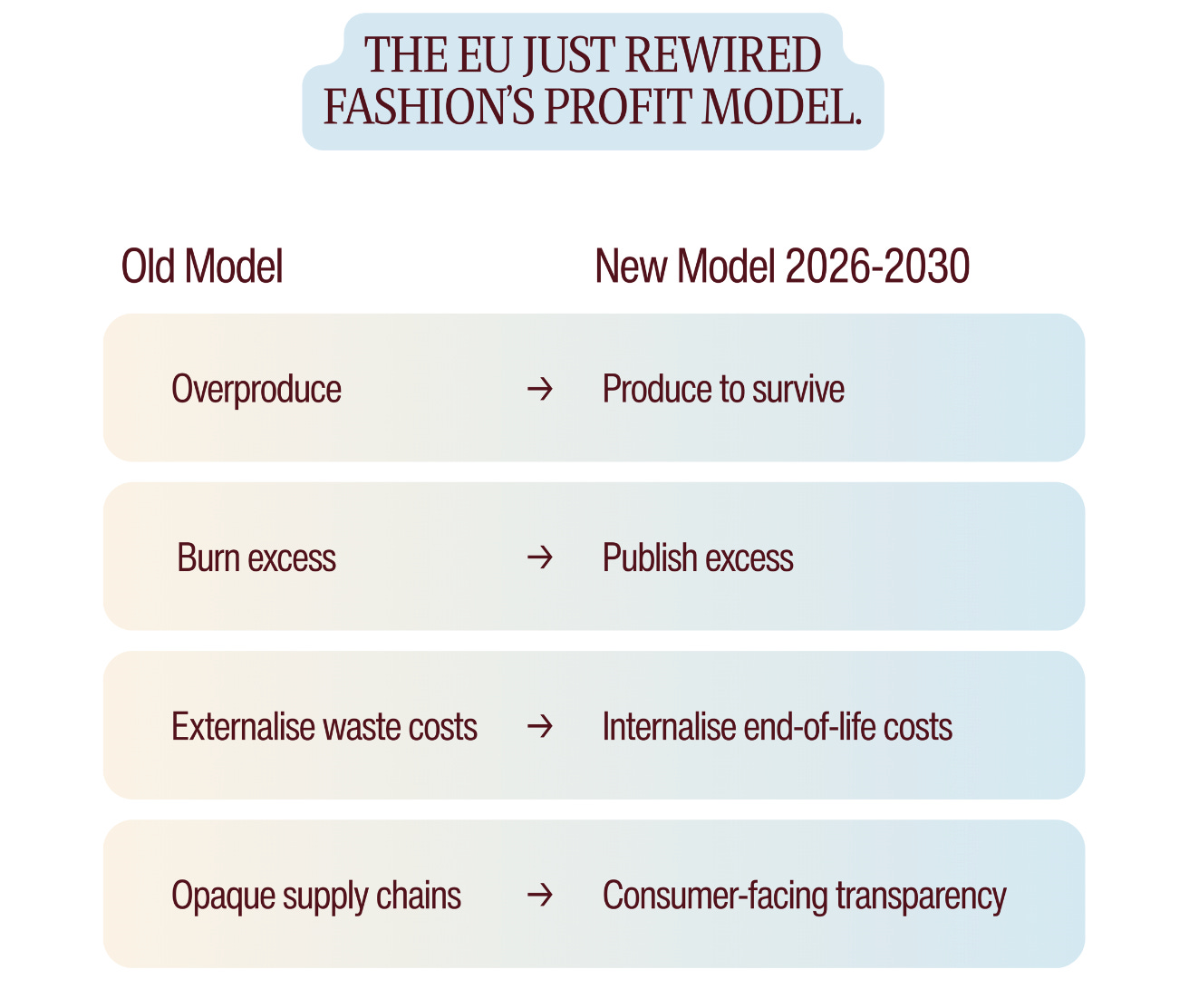
The EU’s new regulatory framework doesn’t just introduce sustainability rules, it rewires the economic logic of fashion.
Design decisions will now affect compliance, transparency will move from internal reports to consumer interfaces and the cost of waste will shift directly onto brands.
Welcome to the EU Fashion Regulatory Stack.
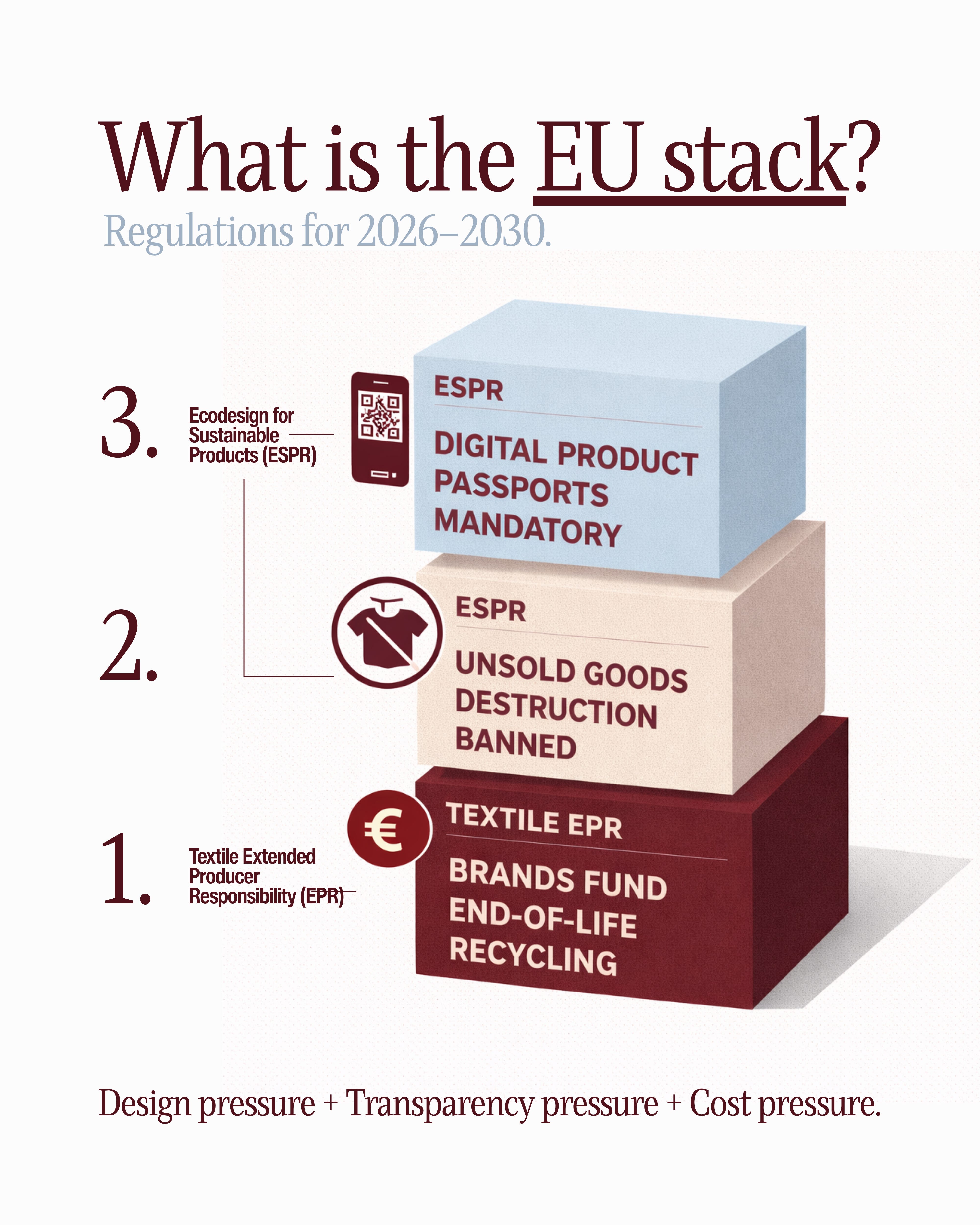
The EU Regulatory Stack (2026–2030)
Three major policies will shape how fashion operates in the coming decade:
Let’s break them down. ↓
1. Textile Extended Producer Responsibility (EPR)
If you produce it, you fund its end of life.
Under Textile EPR, brands become financially responsible for the lifecycle of the products they put into the market.
This means companies will be required to fund:
Textile collection
Sorting infrastructure
Recycling systems
Waste management
In practice, brands will pay fees based on the recyclability of their products.
Better design → lower fees
Hard-to-recycle products → higher fees
Circularity stops being a marketing concept and becomes a financial incentive system.
For the first time, product design decisions directly affect regulatory costs.
2. The Ban on Destroying Unsold Apparel
For years, brands quietly destroyed unsold inventory.
Burning excess product protected brand value and prevented discounting.
That era is ending.
Under the Eco-design for Sustainable Products Regulation (ESPR), companies will be banned from destroying unsold clothing and footwear.
This forces brands to confront a problem the industry has long hidden:
Overproduction.
When unsold goods can no longer disappear through incineration, they become visible.
And visibility changes behaviour.
Brands will have to rethink forecasting, production volumes, and inventory management in ways the industry has avoided for decades.
3. Digital Product Passports (DPP)
The third layer is perhaps the most transformative.
Every product sold in the EU will require a Digital Product Passport.
A tap or scan will may reveal key product data (yet to be decided by EU) including:
Material composition
Supply chain information
Carbon footprint
Repairability
Recyclability
Lifecycle impact
For the first time, transparency moves out of hidden sustainability reports and directly into the consumer’s hand.
Products will effectively start talking.
This creates a new dynamic where brands must ensure the information attached to their products is accurate, structured, and accessible across the supply chain.
Digital infrastructure becomes as critical as physical production.
We are building DPPs that people actually care about.
At IoDF Platform, we have always been at the root of fashion, culture, and emerging technology, which is exactly where Digital Product Passports need to be built.
While many conversations around DPPs focus purely on compliance, we see them as product infrastructure that sits inside culture, brands, and consumer experience.
Through IoDF Platform we are actively developing the technology layer for Digital Product Passports, while running proof-of-concept pilots with both SMEs and enterprise brands to test real-world implementation across products and supply chains.
Our approach is culture-first and technology-driven, powered by deep industry insight and close proximity to designers, brands, and creative communities.
The goal is simple: build Digital Product Passports that people actually care about, not just systems that satisfy regulation.
Want to run a POC with IoDF Platform and download our DPP Insights guide? ↓
Click Link For Access 💌
Right now, many brands are being sold “full Digital Product Passport compliance.”
The reality is: final regulatory frameworks are still evolving.
Across the EU and wider markets, the detailed technical requirements, data structures, and enforcement timelines are not fully defined yet. This means that implementing a fixed “compliance solution” today often leads to systems that will need to be rebuilt once the final standards are confirmed.
The most effective step brands can take right now is experimentation and preparation.
This is where IoDF Proof-of-Concept activations become critical.
POCs allow brands to:
• Test Digital Product Passport infrastructure in real-world conditions
• Understand what data systems will actually be required
• Explore customer interaction and engagement with product identity
• Prototype interfaces and product storytelling
• Prepare internal teams for upcoming regulatory change
At IoDF Platform, we work with brands to build structured DPP experiments that generate insight without locking companies into premature compliance architectures.
We are currently onboarding a limited number of brands into early-stage infrastructure engagements ahead of regulatory enforcement.
SO helpful thank you